Scite
The Autohive Scite integration connects Scite’s research and regulatory intelligence platform with Autohive’s automation platform, enabling:
- Literature search - Search full-text scientific literature across 210M+ papers, with Smart Citation evidence, editorial notices, and open-access excerpts
- Collections - Create, update, and manage curated DOI lists for tracking and analysing sets of papers over time
- Clinical trials - Search and retrieve full clinical trial records, including eligibility criteria, outcomes, and reported adverse events
- FDA drug data - Search approved drug records (Structured Product Labels, Orange Book, Drugs@FDA)
- FDA adverse events - Search FAERS drug adverse event reports and MAUDE medical device adverse event reports
- FDA device clearances - Search 510(k) clearance metadata and the full narrative text of 510(k) summary submissions
- MHRA alerts - Search UK drug and medical device safety alerts and publications
- Grants - Search research funding records from NIH, NSF, SBIR/STTR, Wellcome, EU, and more
- Patents - Search patent families related to research topics
Install the integration
Scite uses OAuth authentication through its hosted MCP connector.
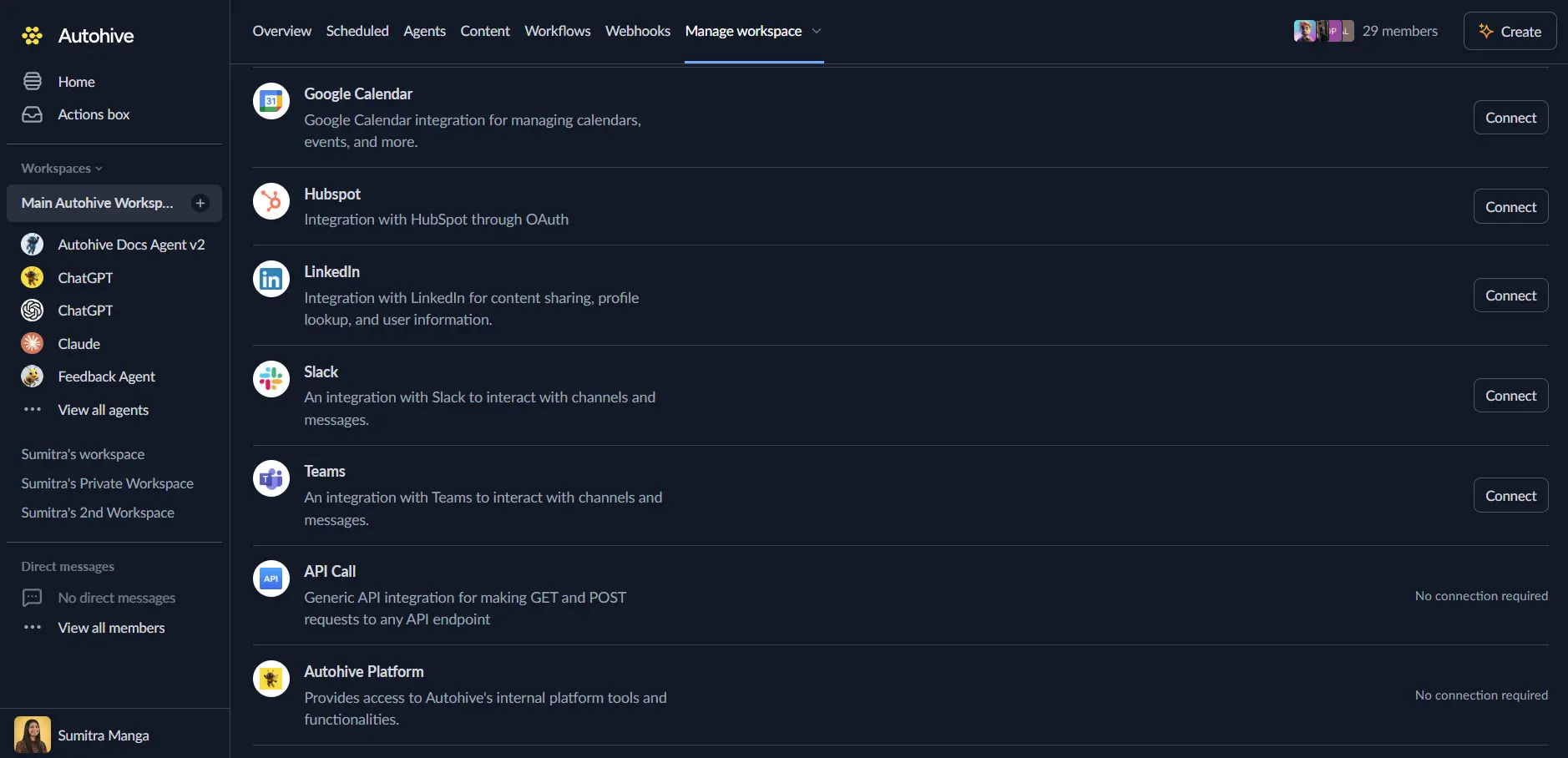
Log in to Autohive and navigate to Your user profile > Connections or Your workspace → Manage workspace
Locate the Scite Integration card and click Connect
You’ll be redirected to Scite — log in with your Scite account (a Scite Premium or Enterprise subscription is required) and authorise Autohive to access the MCP server
You’ll be redirected back to Autohive with the integration showing as “Connected”
Use the integration
You can now use the integration with your agents, workflows, and scheduled tasks!
- Follow our Create your first agent guide on how to create an agent.
- In the Agent settings, scroll down to the Add capabilities section and turn on the Scite capability. You can choose which individual Scite capabilities to turn on and off.
- Once the settings have been selected, begin prompting the agent with the workflow you’d like to achieve with Autohive and Scite!
Available capabilities
Scite spans literature research, curated Collections, and regulatory/clinical intelligence, grouped below by area.
Literature search
- Search Literature - Search 210M+ papers by keyword, DOI, title, author, journal, affiliation, publisher, topic, or publication type, with filters for date range and minimum supporting/contrasting/mentioning/citing-publication counts, and editorial-notice filters (retractions, corrections, concerns, errata). Returns metadata, abstract, Smart Citation snippets (supporting/contrasting/mentioning), full-text excerpts for open-access papers, citation tallies, and resolved access links
Collections
- Create Collection - Create a new DOI-list Collection, optionally seeded with DOIs
- Get Collection - Retrieve a Collection’s details by slug
- Search Collections - List Collections you can access, optionally filtered by name
- Update Collection - Rename, redescribe, or replace the DOI list of a Collection
- Delete Collection - Permanently delete a Collection
- Add DOIs to Collection - Add DOIs to a DOI-list or saved-search Collection
- Remove DOIs from Collection - Remove DOIs from a Collection
Clinical trials
- Search Clinical Trials - Search ClinicalTrials.gov by condition, intervention, sponsor, or NCT ID
- Get Clinical Trial - Retrieve a trial’s full record, including eligibility criteria, outcomes, enrollment, reported adverse events, and related publications
FDA drug data
- Search Drugs - Search FDA drug records (Structured Product Labels, Orange Book, Drugs@FDA) by brand/generic name, active substance, manufacturer, or indication
- Get Drug - Retrieve a drug’s full approved products list and complete label sections (indications, dosage, warnings, adverse reactions, pharmacology)
FDA drug adverse events (FAERS)
- Search FAERS - Search FDA Adverse Event Reporting System reports by drug name, reaction term, or manufacturer
- Get FAERS Report - Retrieve a report’s full patient demographics, dosage details, and reporting source
FDA device adverse events (MAUDE)
- Search MAUDE - Search FDA medical device adverse event reports by device name, manufacturer, or event description
- Get MAUDE Report - Retrieve a report’s full narrative text, reporter details, and patient treatment information
FDA device clearances (510(k))
- Search Device 510(k) - Search FDA 510(k) premarket notification clearances by device name, product code, or applicant
- Get Device 510(k) - Retrieve a clearance’s full summary text, applicant details, and decision metadata
- Search 510(k) Summaries - Full-text search across the narrative content of 510(k) summary PDF submissions
- Get 510(k) Summary - Retrieve the complete full text of a 510(k) summary document, organised by page
MHRA alerts (UK)
- Search MHRA - Search UK MHRA drug safety alerts, medical device alerts, and field safety notices
- Get MHRA Alert - Retrieve an alert’s full article text
Grants
- Search Grants - Search research grants from NIH RePORTER, NSF, SBIR/STTR, Wellcome, EU, and other funders by topic, PI, organisation, or agency
- Get Grant - Retrieve a grant’s full abstract and source-specific identifiers
Patents
- Search Patents - Search patent families by keyword, inventor, or assignee
Key features
Smart Citations
Rather than a simple citation count, every citing relationship in a literature search is classified as supporting, contrasting, or mentioning, with the exact quoted sentence from the citing paper. This lets an agent assess the weight and direction of evidence behind a claim, not just whether it was cited.
One connector, many regulatory sources
Beyond literature, the same integration reaches clinical trials, FDA drug labels, FDA adverse event databases (FAERS and MAUDE), FDA device clearances (including full-text 510(k) summaries), UK MHRA alerts, grants, and patents — letting an agent cross-reference a drug, device, or research topic across sources without switching tools.
Retraction and correction detection
Editorial notices surface retractions, corrections, and expressions of concern directly on literature search results, so an agent can flag unreliable sources before citing them.
Curated Collections
Collections let you build and maintain a tracked set of DOIs — either a manual list or a saved search with manual include/exclude overrides — for ongoing monitoring or team sharing.
Full-text regulatory search
510(k) summary search and clinical trial detail return full narrative text (test results, substantial equivalence reasoning, eligibility criteria), not just structured metadata.
Common use cases
Literature review and fact-checking
- Search broadly on a topic, then drill into the most relevant or highly-cited papers
- Compare supporting versus contrasting Smart Citation counts to gauge scientific consensus
- Check editorial notices for retractions before citing a source
Drug and device safety research
- Look up a drug’s approved label, then cross-reference FAERS adverse event reports for real-world safety signals
- Look up a medical device’s 510(k) clearance and full summary text, then check MAUDE reports for related adverse events
- Search MHRA alerts for UK-specific safety communications on the same drug or device
Clinical trial discovery
- Search trials by condition or intervention, then pull full eligibility criteria and outcomes for patient-trial matching
- Review a trial’s reported adverse events and related publications
Grant and patent landscape research
- Search grants to find who is funding research in a given area
- Search patents to find related technology and prior art for a research topic
Building tracked reading lists
- Create a Collection of DOIs for a research project and add or remove papers as the review progresses
- Share a Collection with a team for ongoing literature monitoring
Disconnect the integration
- Navigate to Your user profile → Connections or Your workspace → Manage workspace
- Find the Scite Integration
- Click Disconnect and confirm
Data Impact: Existing data in your Scite account, including any Collections you’ve created, remains completely unchanged. Disconnecting only removes Autohive’s API access.
About Scite
Scite is a research and regulatory intelligence platform that helps researchers, academics, and professionals discover and evaluate scientific literature using Smart Citations — citation statements classified as supporting, contrasting, or mentioning, drawn directly from the full text of citing papers. Its platform also spans clinical trials, FDA drug and device regulatory data, UK MHRA alerts, grants, and patents. A Scite Premium or Enterprise subscription is required to use the MCP connector.